Home
Log In
Acousto Optic Modulator
Acousto Optic AOFS
Acousto Optic Deflectors
AOM Applications
AOTF Tunable Filters
Q-switches Isolator
Fiber Laser Modulators
Categories
Acousto Optic Modulator
(24)
Acousto Optic AOFS
(9)
Acousto Optic Deflectors
(6)
AOM Applications
(1)
AOTF Tunable Filters
(4)
Q-switches Isolator
(6)
Fiber Laser Modulators
(6)
Categories
Acousto Optic Modulator
(24)
Acousto Optic AOFS
(9)
Acousto Optic Deflectors
(6)
AOM Applications
(1)
AOTF Tunable Filters
(4)
Q-switches Isolator
(6)
Fiber Laser Modulators
(6)
Reviews [more]
Write a review on this product.
Reviews [more]
Write a review on this product.
Featured [more]
1064nm 60MHz-200MHz Free Space Acousto-Optic Modulator AOM
$2,580.00
Information
About Us
Shipping & Returns
Privacy Notice
Conditions of Use
Contact Us
Information
About Us
Shipping & Returns
Privacy Notice
Conditions of Use
Contact Us
Home
::
Acousto Optic Modulator
:: 1600nm Fiber-coupled AOM for Self Heterodyne Line width Measurement
Acousto Optic Modulator
Product 14/24
Previous
Return to the Product List
Next
1600nm Fiber-coupled AOM for Self Heterodyne Line width Measurement
1600nm Fiber-coupled AOM for Self Heterodyne Line width Measurement
Ask a Question
$2,650.00
Add to Cart:
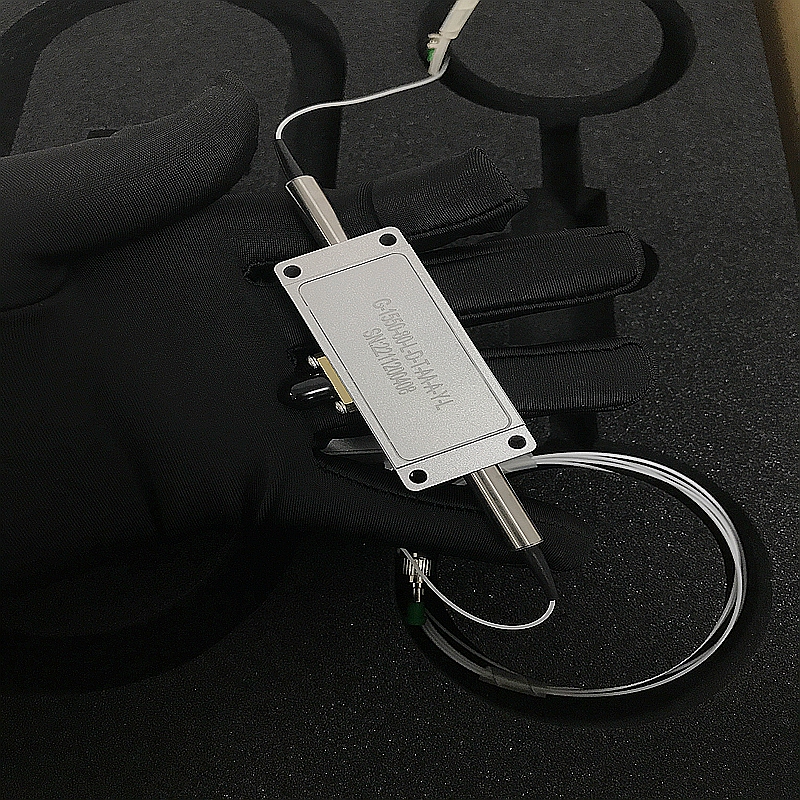
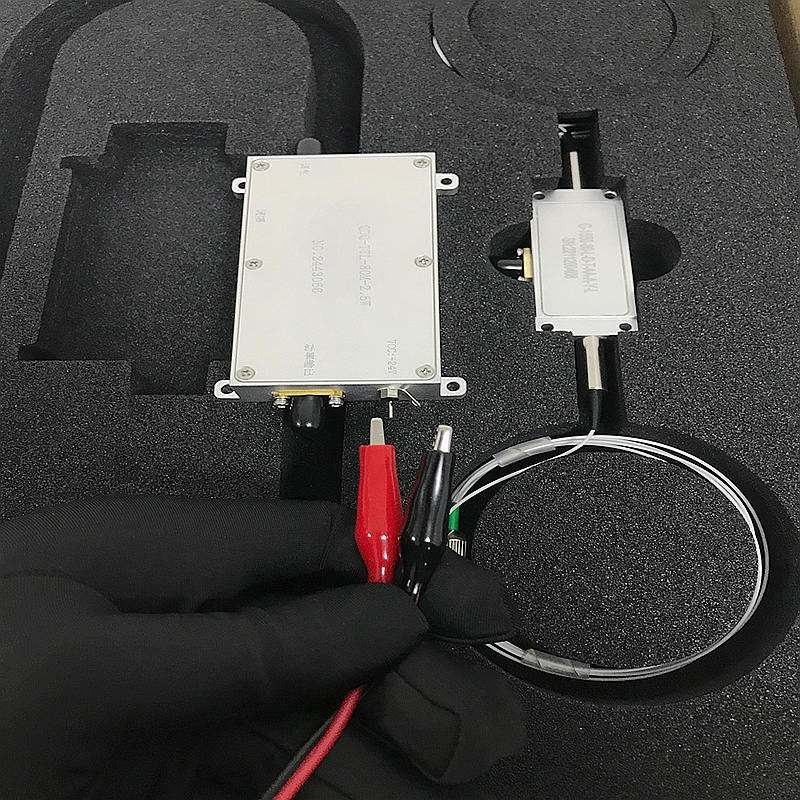
1600nm Fiber-coupled Acousto-optic Modulator Optical AOM with its driver for Self Heterodyne Line width Measurement.
Features:
Low insertion loss
Compact and stable performance
Custom configuration
Application:
Optical switch laser wavelength shifting
Material:TeO2
Wavelength:1600
Insertion loss: 4200m/s
Extinction Ratio: 4.5dB
Rising edge time:30ns
Frequency: 80MHz
Frequency shift:+/-80MHz
RF power: 2.5W
Voltage Standing Wave Ratio:1.2:1
input resistance: 50
Device interface:SMA
Fiber type:PM/SM
Fiber length: 1.5m
Fiber Interface:FC/APC
Operating temperature:-20~+60
Storage temperature: -30~+70
Self Heterodyne Line width Measurement for lasers
The self-heterodyne method is a heterodyne technique which can be used to measure the linewidth (width of the optical spectrum) of a laser, particularly a single-frequency laser. The basic setup is shown in Figure 1. One portion of the laser beam is sent through a long optical fiber which provides some time delay.
Another portion is sent through an acousto-optic modulator (AOM), which is driven with a constant frequency (typically some tens of megahertz) and shifts all the optical frequency components by that frequency. Both beams are finally superimposed on a beam splitter, and the resulting beat note (centered at the AOM frequency) is recorded with a photodetector (typically a photodiode). From this signal, the laser linewidth can then be calculated.
For sufficiently long delays, the superimposed beams are essentially uncorrelated, and the output spectrum becomes a simple self-convolution of the laser output spectrum, from which the laser linewidth is easily retrieved. However, what sufficiently long means in a specific case, can be a difficult question. The criterion which is usually used is that the delay length must be larger than the coherence length, and the latter is derived from the (measured) linewidth itself. This is correct for white frequency noise, but not in situations with higher (e.g. ) low-frequency noise, as can occur e.g. for narrow-linewidth fiber lasers. If such issues are not completely understood, the measured linewidth values may be wrong (often too low).
The delay time in the self-heterodyne setup can be interpreted as a finite measurement time, which implies that the impact of noise frequencies below that inverse measurement time is low. A consequence of that is that measurements with shorter delay time yield smaller linewidth values if the instantaneous frequency fluctuations exhibit substantial noise, as is the case for many laser diodes.
For lasers with a very narrow line width (long coherence length), it may not be practical to have a long enough time delay to obtain uncorrelated beams. In that case, shorter delays can be used, but the data processing then has to be substantially more sophisticated. Another possibility is to use an extension of this method, based on recirculating fiber loops
Write Review
Home