Home
Log In
Acousto Optic Modulator
Acousto Optic AOFS
Acousto Optic Deflectors
AOM Applications
AOTF Tunable Filters
Q-switches Isolator
Fiber Laser Modulators
Categories
Acousto Optic Modulator
(24)
Acousto Optic AOFS
(9)
Acousto Optic Deflectors
(6)
AOM Applications
(1)
AOTF Tunable Filters
(4)
Q-switches Isolator
(6)
Fiber Laser Modulators
(6)
Categories
Acousto Optic Modulator
(24)
Acousto Optic AOFS
(9)
Acousto Optic Deflectors
(6)
AOM Applications
(1)
AOTF Tunable Filters
(4)
Q-switches Isolator
(6)
Fiber Laser Modulators
(6)
Reviews [more]
Write a review on this product.
Reviews [more]
Write a review on this product.
Featured [more]
1064nm 60MHz-200MHz Free Space Acousto-Optic Modulator AOM
$2,580.00
Information
About Us
Shipping & Returns
Privacy Notice
Conditions of Use
Contact Us
Information
About Us
Shipping & Returns
Privacy Notice
Conditions of Use
Contact Us
Home
::
Acousto Optic AOFS
:: 1550nm Fiber-coupled Acousto-optic Modulator/Frequency Shifter AOFS
Acousto Optic AOFS
Product 1/9
Previous
Return to the Product List
Next
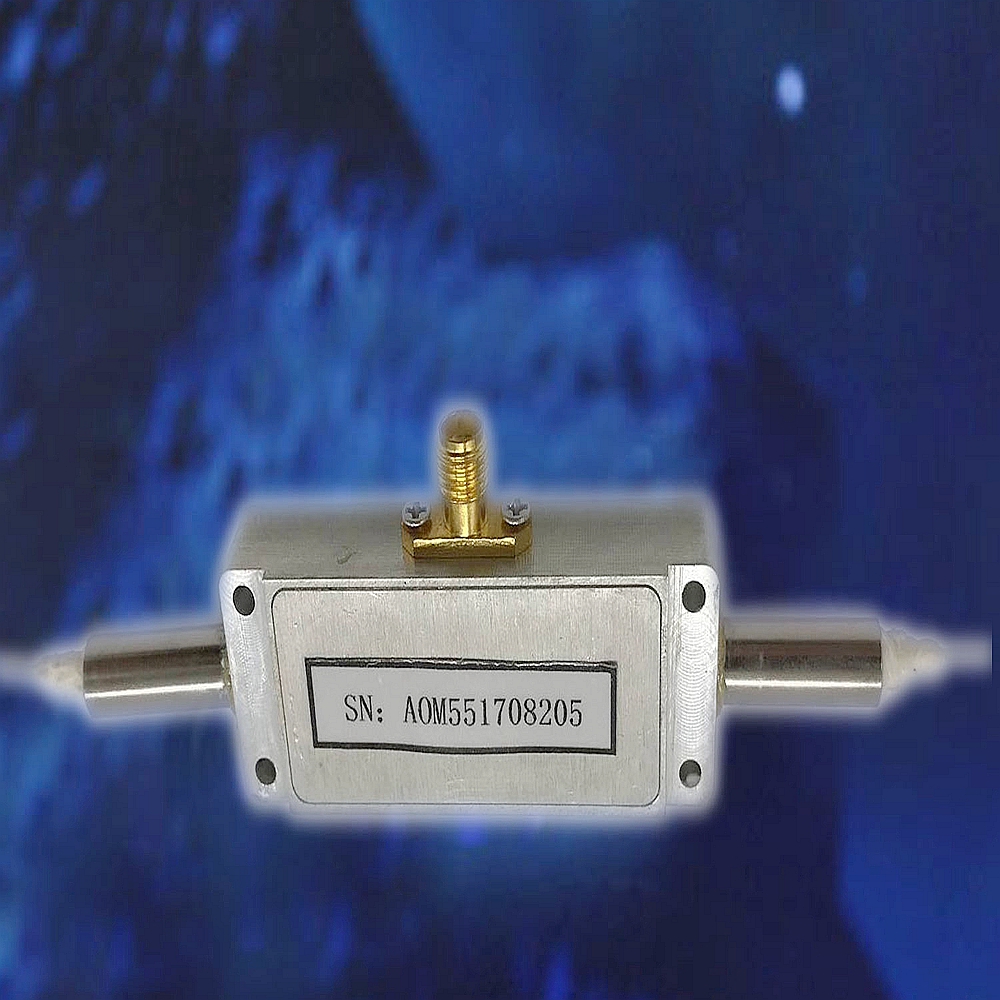
1550nm Fiber-coupled Acousto-optic Modulator/Frequency Shifter AOFS
1550nm Fiber-coupled Acousto-optic Modulator/Frequency Shifter AOFS
Ask a Question
$2,600.00
Add to Cart:
1550nm Fiber-coupled Acousto-optic Modulator/Frequency Shifter AOFS
Feature:
Low insertion loss
Compact
Stable performance
Custom Configuration
General performance Parameters
Material: TeO2
Wavelength: 1550 NM
Average optical power: 1W
Peak (pulse) optical power: 1kW
Ultrasonic speed of Sound: 4200m/s
Insertion loss: 1.5 ~ 2.5 DB
Extinction ratio: DB
Echo Loss: DB
Rise along time: NS
Frequency:
Frequency Shift: +/-80 MHz
RF Power: 2.5W
Voltage standing wave ratio: 1.2:1
Input impedance: 50ω
Device Interface: SMA
Fiber Type: PM/SM
Fiber Length: 1.5 m
Fiber Optic Interface: FC/PC/APC
Operating Temperature: -20~+60℃
Storage Temperature: -30~+70℃
Introduction:
Acousto optic modulator works based on Acoustic optic effect. This effect deals with modulation of optical property through variation of refractive index of the medium under the influence of acoustic wave.
All the Acousto Optic devices work based on photo-elastic effect or by interaction of acoustic waves and light in the crystalline material. An acoustic waves are generated in the crystal by application of RF drive signal to piezo-electric transducer. This creates areas of compression and refraction in the crystal bulk. This causes periodic changes in the refractive index. As a result light input to AO (Acousto Optic) device is diffracted into number of orders at the output. The acoustic wave travels from transducer to absorber. It is used to prevent creation of secondary diffractions due to reflections.
Most of the Acousto-optic (AO) devices are designed to maximize diffraction of input laser beam into a single first order position. The device is then said to be operating in the Bragg regime and requires the AO device to be correctly aligned and the drive power adjusted at or below the RF saturation level.
Acousto optic modulator frequency shift formula or equation
The diffracted beam is frequency shifted from the incident laser beam or light beam by an amount equal to the RF frequency (f). By changing the orientation of the AOM (Acousto optic modulator) with respect to the incident beam, the diffracted beam can be produced at frequencies fL+f or fL - f.
➨ Frequency shift = fL +/- f
Where,
fL is the laser frequency and f is the RF frequency used to produce acoustic wave.
The frequency shift depends on conservation of momentum by interaction of laser beam and acoustic wave.
Write Review
Home